


A practical guide to Turkish paper marbling arrives on 12 November, the week an ebru-inspired tulip takes centre stage at the UN climate summit in Antalya.
A drop of colour spreads across a tray of thickened water. With a fine metal tool, the artist draws it out into a petal. A few more movements give the flower its stem and leaves. Then a sheet of paper is laid gently over the water and lifted away, carrying the finished design.
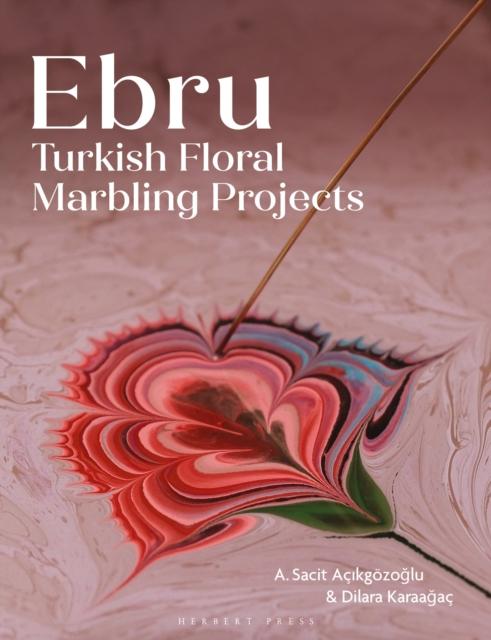
This is ebru, the Turkish art of paper marbling, and the subject of a new book by Istanbul master Ahmet Sacit Açıkgözoğlu and London-based artist Dilara Karaağaç. Published in the UK on Thursday 12 November by Herbert Press, Ebru: Turkish Floral Marbling Projects shows readers how to make everything from a single carnation to a bouquet of tulips.
The authors first worked together as teacher and pupil. Karaağaç trained under Açıkgözoğlu in Istanbul between 2007 and 2012, following the traditional master-apprentice model. He is now rector of Mimar Sinan Fine Arts University in Istanbul, while she teaches ebru at the Yunus Emre Institute in London and promotes the craft through her Traditional Turkish Arts platform.
The book opens with the history of ebru and a guide to preparing the materials. Hundreds of photographs take readers through the projects, showing how to place and move the colours with a fine tool called a biz. There are hyacinths, poppies and daisies to try, as well as more intricate projects such as making two flowers in one tray and using a mask to keep selected areas clear, a technique known as akkase.
From Ottoman manuscripts to the COP31 logo
The origins of paper marbling are debated. In the Ottoman Empire, ebru became part of the book arts, used for bindings and endpapers and to frame panels of calligraphy. Marbled paper was being made across much of Europe by the 17th century. One particularly inventive British example came in 1761, when Laurence Sterne put a hand-marbled page inside the third volume of Tristram Shandy. Each copy had a different pattern.
Many of the naturalistic flowers now associated with Turkish ebru owe much to the 20th-century Istanbul master Necmeddin Okyay, who developed recognisable tulips, carnations and hyacinths on water. His pupil Mustafa Düzgünman added the daisy. In 2014, UNESCO inscribed ebru on its Representative List of the Intangible Cultural Heritage of Humanity.
This week the tulip has a much bigger audience. The logo for COP31, the UN climate conference taking place in Antalya from 9 to 20 November, draws on ebru and Turkish tilework. In the organisers’ logo film, floating colours take shape as a tulip. Turkish artist Garip Ay also recreated the emblem in ebru in New York’s Times Square during September’s New York Climate Week.

On a more everyday scale, Portsmouth artist James Mouland applies ebru to silk scarves and cushions, while London marbler Lucy McGrath has brought hand-marbled stationery and gifts to shops including Liberty and Fortnum & Mason through her studio, Marmor Paperie.
Where to try marbling in the UK
Heritage Crafts reports growing interest in marbling, helped by social media. It still classes highly skilled marbling as endangered in the UK, where there are fewer traditional bookbinders and fewer opportunities to train as an apprentice.
Karaağaç’s autumn beginners’ course is already under way at the Yunus Emre Institute in London, and she also taught a one-day course at West Dean’s London campus in October. In Masham, North Yorkshire, artist Bade Kafadar is due to lead a traditional Turkish paper marbling workshop at ArtisOn on Thursday 19 November.

Mouland has taught ebru at Portsmouth Museum and Art Gallery. In Scotland, the Edinburgh Remakery has run paper marbling workshops, and Edinburgh’s Ash Lab Art Studio offers classes in lacquer marbling, a different technique that also lets participants lift a floating pattern onto paper.
Book details
Title · Ebru: Turkish Floral Marbling Projects
Authors · Ahmet Sacit Açıkgözoğlu and Dilara Karaağaç
UK publication · Thursday 12 November 2026
Publisher · Herbert Press, an imprint of Bloomsbury Publishing
Paperback · 176 pages, £25 RRP
ISBN · 9781789943726
All images from Ebru: Turkish Floral Marbling Projects, courtesy of Herbert Press / Bloomsbury