
Istanbul Airport has overtaken London Heathrow as Europe’s busiest airport, marking a major milestone for Türkiye’s rapidly expanding aviation sector and one of the clearest signs yet of Istanbul’s emergence as a global transport hub.
The Turkish airport handled 8.15 million passengers in July, nearly 300,000 more than the 7.86 million who passed through Heathrow during the same month. Istanbul’s July 2026 traffic was up 2.3% year-on-year, while Heathrow suffered a 1.5% fall.
More significantly, the latest figures indicate Istanbul has also edged ahead over the first seven months of 2026.
Türkiye’s Transport and Infrastructure Minister Abdulkadir Uraloğlu said Istanbul Airport handled 48,068,524 passengers between January and July, including more than 38 million international travellers.
Heathrow had welcomed 40 million passengers during the first half of the year and another 7.86 million in July, putting its comparable seven-month total at roughly 47.86 million.
The change at the top has been coming for some time.
According to Airports Council International Europe (ACI Europe), Heathrow narrowly retained its position as Europe’s busiest airport in 2025, with 84.48 million passengers. Istanbul was just behind on 84.44 million — a gap of only around 40,000 passengers over an entire year. Crucially, Istanbul’s traffic had grown by 5.5%, compared with growth of just 0.7% at the capacity-constrained London airport.
Heathrow had been Europe’s dominant airport for much of the previous three decades, holding the number one position from 1996 until 2019. It lost the crown during the Covid pandemic before returning to the top in 2023.
Istanbul Airport’s spectacular rise
What makes Istanbul’s achievement particularly striking is the speed with which the airport has risen to the top.
Istanbul Airport only started operations on 29 October 2018, taking over most commercial traffic from the city’s former main hub, Atatürk Airport.
Its first phase was designed to accommodate 90 million passengers annually, while its eventual planned capacity is 200 million passengers a year. Turkish Airlines describes Istanbul Airport as its new global home, with connections to more than 350 destinations.
The airport has benefited from Istanbul’s geographical position between Europe, Asia, the Middle East and Africa, as well as the extraordinary international growth of Turkish Airlines, whose extensive network has turned the city into a natural transfer point for passengers travelling between continents. Turkish Airlines says it now flies to more countries than any other airline.
Those structural advantages contrast with Heathrow, whose two runways operate at close to full capacity.
The London airport has seized on Istanbul’s rise to renew its longstanding case for a third runway, saying after the July figures that the “case for expansion has never been clearer”. Its proposed expansion would eventually allow Heathrow to handle as many as 150 million passengers a year.
Heathrow’s performance this year has also been affected by geopolitical turmoil. Passenger numbers on its Middle East routes fell 20.2% year-on-year in July, while Heathrow’s own half-year results showed Middle East passenger traffic down 25% during the first six months of 2026.
Even so, Istanbul’s rise cannot simply be put down to a bad month at Heathrow. The two airports were virtually level across the whole of 2025, and Istanbul has continued to add capacity while Heathrow has little room for further growth without major new infrastructure.
The Turkish hub also looks set to retain its momentum. Aviation data specialist OAG ranks Istanbul as Europe’s busiest airport by scheduled airline capacity for August 2026, with 4.83 million seats compared with Heathrow’s 4.51 million.
For Türkiye, becoming home to Europe’s busiest airport represents a remarkable turnaround in little more than seven years.
From a vast new airport opening on Istanbul’s outskirts in 2018 to overtaking one of the world’s most established aviation hubs, Istanbul Airport has rapidly become one of the most important gateways in global air travel — and, on current trends, its lead over Heathrow may only grow.
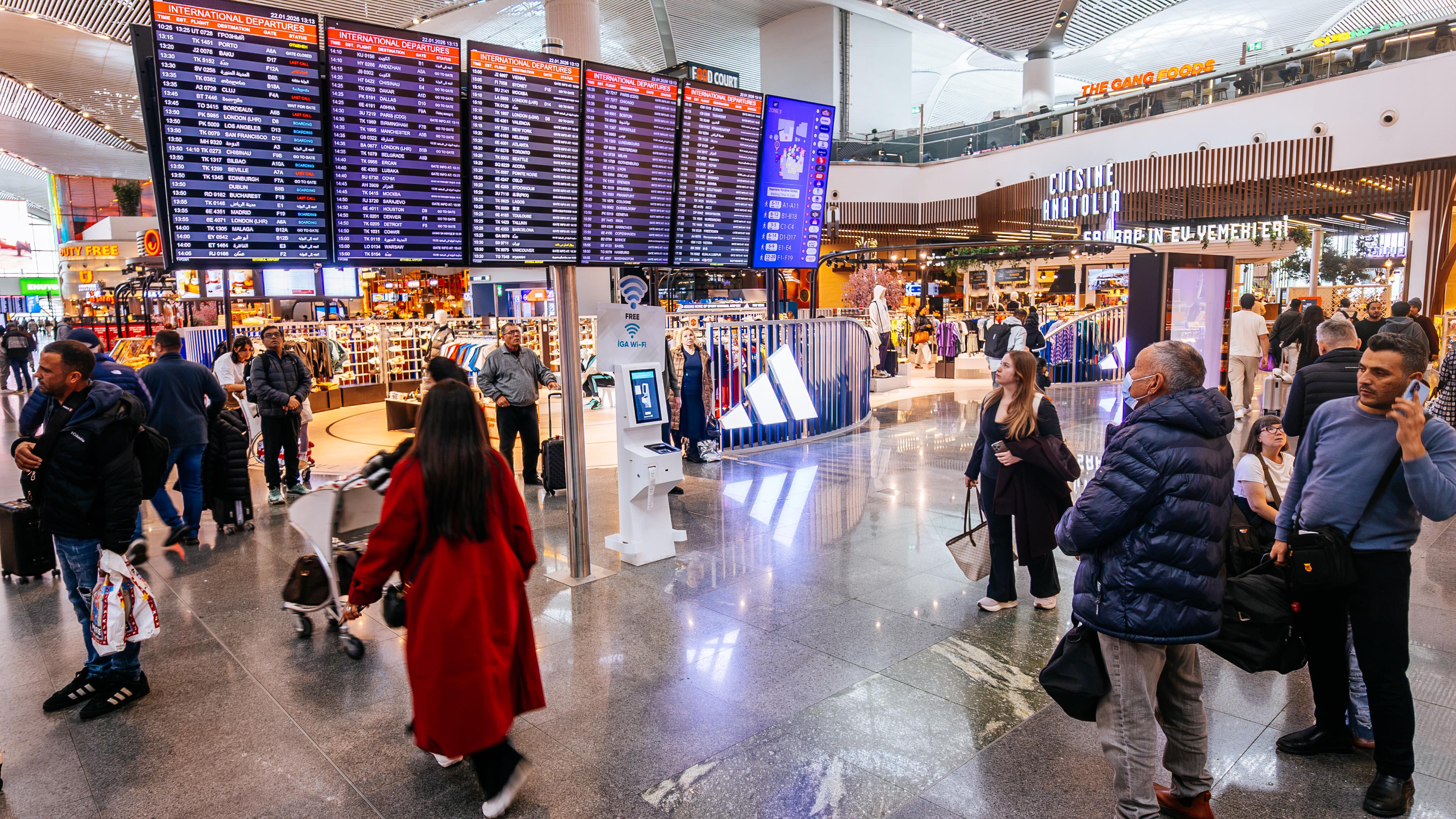
Main image, top, of passengers checking flight information departure boards inside the main concourse of the terminal at Istanbul Airport, Jan 2026. Photo © Andrey Danilovich/iStock