

Font size:
Print
Ersin Tatar, leader of the National Unity Party (UBP), and Kudret Özersay, who heads the People’s Party (HP), signed a protocol yesterday, 22 May, setting out their principles of the new coalition government. The two parties hold 21 and nine seats respectively in the 50-seat TRNC Parliament, giving them a solid majority.
The government is the 35thsince the TRNC was established 36 years ago, according to Turkish Cypriot media.
The protocol, among other things, stresses the need for “more realistic models” to be discussed during negotiations with the Greek Cypriot side due to the failure to form a federation over the last half century.
The document also calls on the sharing of any natural gas and oil reserves discovered around the island of Cyprus.
“The government of the TRNC will protect its legitimate rights and interests in the Eastern Mediterranean region in total cooperation and solidarity with the Republic of Turkey and will bring up its rightfulness in this subject on every available international platform,” the protocol said.
Mr Tatar told the cameras at the protocol signing ceremony in Parliament that he had decided to establish a “serious, determined and stable coalition government” with the HP.
He said he “trusted” Prof Özersay on the Cyprus problem and that their parties shared the same view on the issue.
Prof Özersay said that North Cyprus was going through a “critical phase” both politically and economically.
He defended his party’s decision to team up with the UBP, saying it had done so “for the sake of not leaving the country without a government and holding early elections”.
“What is more important than what is written in the coalition protocol is implementing what is in that protocol,” Prof Özersay stated.
“We shall work with all our strength to do what is necessary for the welfare of the country.”
He added that Mr Tatar – a Cambridge University graduate, chartered accountant and former finance minister – would bring “invaluable” experience in overcoming the “economic crisis” in the TRNC, sparked by last summer’s large fall in the value of the Turkish lira against major currencies.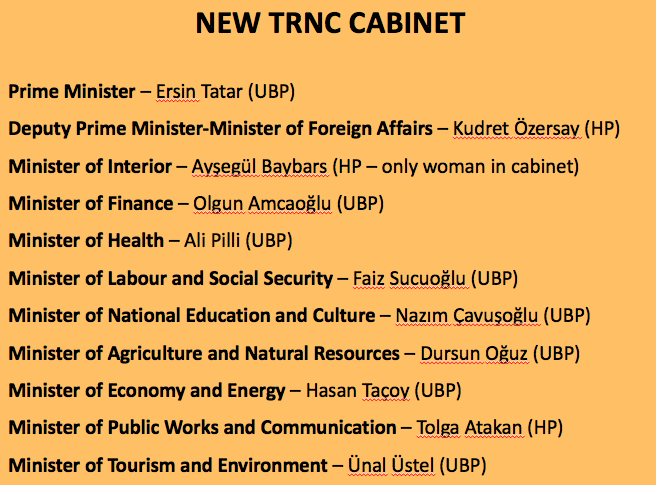 While assembly members of the UBP – founded by the late TRNC President Rauf Denktaş in 1975 and which has spent much of its time in government – unanimously approved the latest coalition, 20 HP assembly members, a third of the total, voted against the partnership.
Prof Özersay set up HP in 2016 off the back of an impressive performance as an independent candidate in the 2015 presidential election, when he won more than 21 per cent of the votes in the first round of voting.
HP came third in its first general election in January 2018, returning nine MPs, after running an anti-corruption campaign. Many of its candidates were people with little or no political background but who were selected because of their professional qualifications and business experience.
During the previous round of coalition talks last year Prof Özersay won plaudits after refusing to enter into a coalition with the then UBP leader Hüseyin Özgürgün.
Eyebrows had been raised over the sources of his personal wealth which emerged during a divorce case, although Mr Özgürgün – who is still an MP, but not a minister – insisted at the time that his finances were above board.
While assembly members of the UBP – founded by the late TRNC President Rauf Denktaş in 1975 and which has spent much of its time in government – unanimously approved the latest coalition, 20 HP assembly members, a third of the total, voted against the partnership.
Prof Özersay set up HP in 2016 off the back of an impressive performance as an independent candidate in the 2015 presidential election, when he won more than 21 per cent of the votes in the first round of voting.
HP came third in its first general election in January 2018, returning nine MPs, after running an anti-corruption campaign. Many of its candidates were people with little or no political background but who were selected because of their professional qualifications and business experience.
During the previous round of coalition talks last year Prof Özersay won plaudits after refusing to enter into a coalition with the then UBP leader Hüseyin Özgürgün.
Eyebrows had been raised over the sources of his personal wealth which emerged during a divorce case, although Mr Özgürgün – who is still an MP, but not a minister – insisted at the time that his finances were above board.
While assembly members of the UBP – founded by the late TRNC President Rauf Denktaş in 1975 and which has spent much of its time in government – unanimously approved the latest coalition, 20 HP assembly members, a third of the total, voted against the partnership.
Prof Özersay set up HP in 2016 off the back of an impressive performance as an independent candidate in the 2015 presidential election, when he won more than 21 per cent of the votes in the first round of voting.
HP came third in its first general election in January 2018, returning nine MPs, after running an anti-corruption campaign. Many of its candidates were people with little or no political background but who were selected because of their professional qualifications and business experience.
During the previous round of coalition talks last year Prof Özersay won plaudits after refusing to enter into a coalition with the then UBP leader Hüseyin Özgürgün.
Eyebrows had been raised over the sources of his personal wealth which emerged during a divorce case, although Mr Özgürgün – who is still an MP, but not a minister – insisted at the time that his finances were above board.