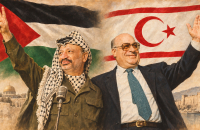

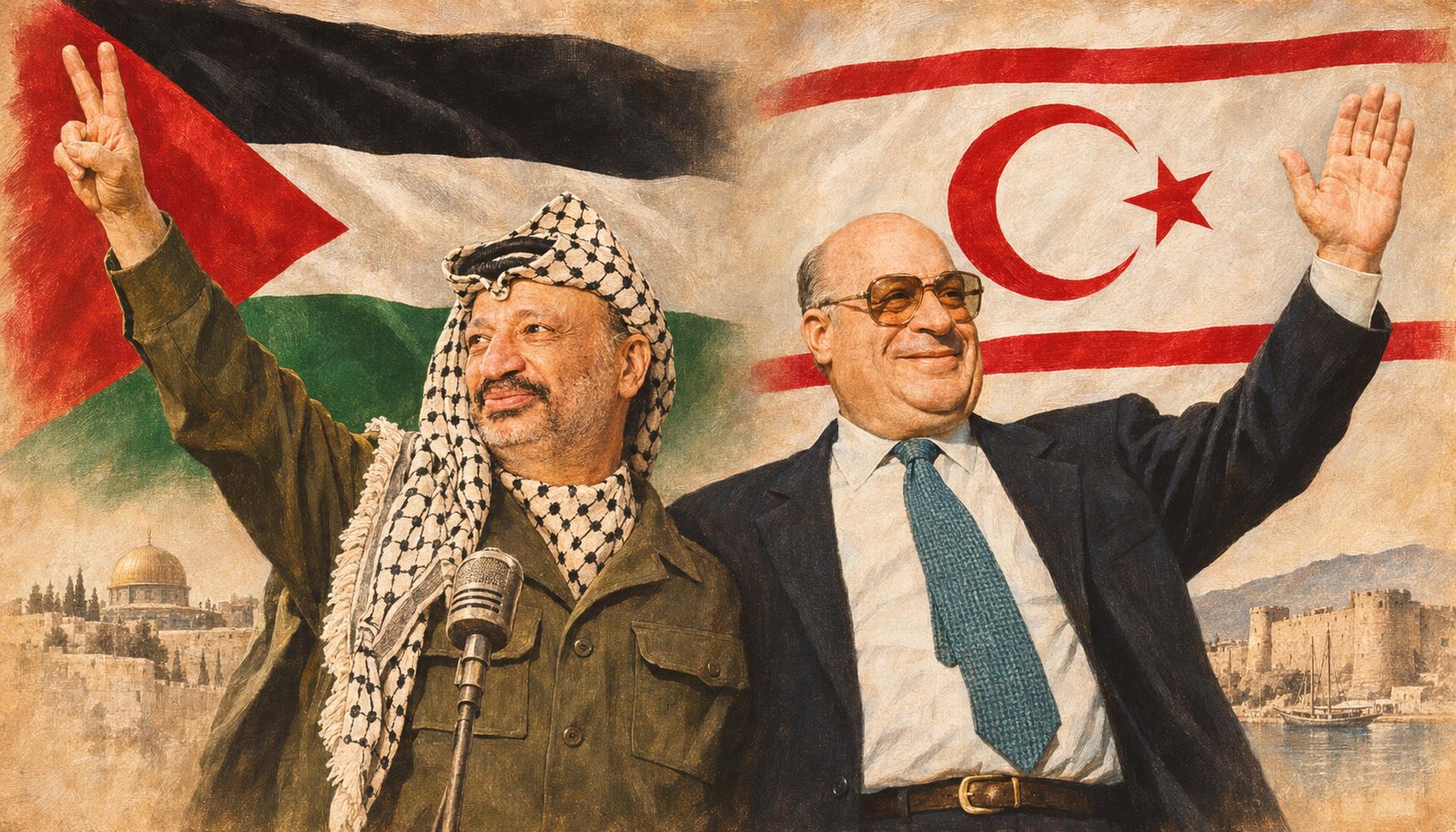
Five years apart, Turkish Cypriots and Palestinians proclaimed their states on 15 November. Their histories had already been entwined for centuries through Ottoman rule, British policy and the journeys of young women sent from Cyprus to marry in Palestine.
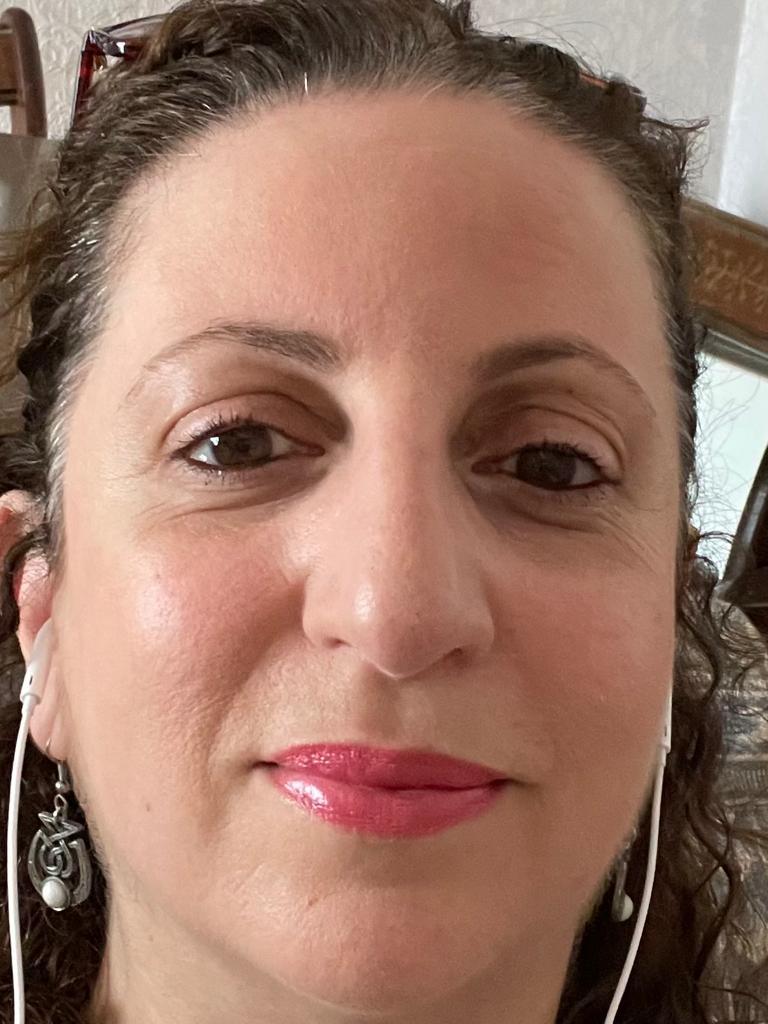
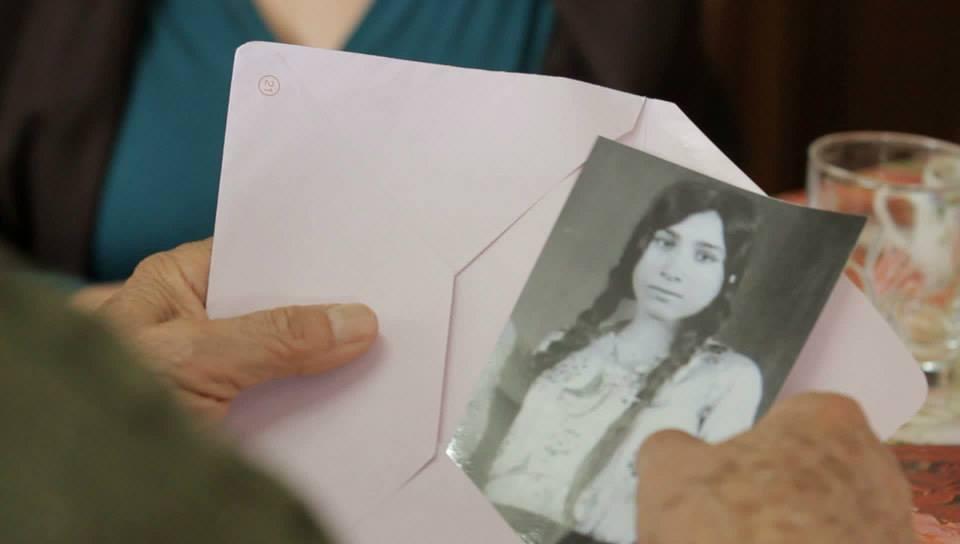
In 1936, 14-year-old Fetine Memish left her village near Limassol to marry a merchant in Palestine. Her family was in debt, the groom paid her father, and Fetine had no say in the marriage. She never returned to Cyprus. Decades later, her great-niece Pembe Mentesh set out with a single photograph (pictured below) to find out what had happened to her. Her search became the documentary Missing Fetine.
Fetine’s story is one of the less familiar links between two neighbours in the Eastern Mediterranean.
Famagusta and Gaza City are about 250 miles apart as the crow flies. The Turkish Republic of North Cyprus (TRNC) covers roughly 3,250 square kilometres, a little over half the combined area of the West Bank, including East Jerusalem, and the Gaza Strip. Both North Cyprus and Palestine mark their declarations of independence this Sunday, 15 November.
1. Two declarations, five years apart
On 15 November 1983, the Turkish Cypriot legislature proclaimed the Turkish Republic of North Cyprus (TRNC) in Lefkoşa, with Rauf Denktaş as its founding president. Three days later, UN Security Council Resolution 541 deemed the declaration legally invalid and called on states to withhold recognition. Türkiye remains the only country to recognise the TRNC.
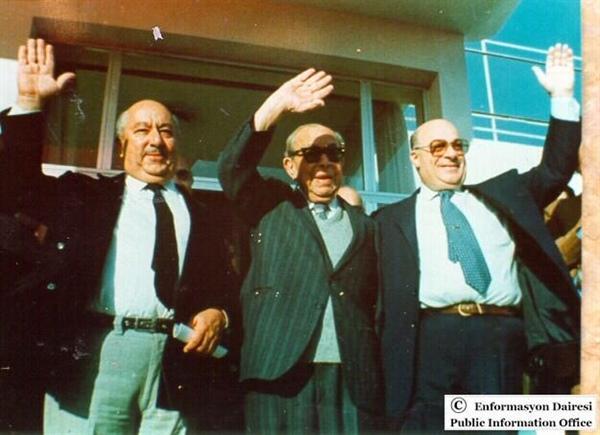
After the declaration of the TRNC on 15 Nov. 1983: (L-R) Osman Örek, Dr Fazıl Küçük, and Rauf Raif Denktaş
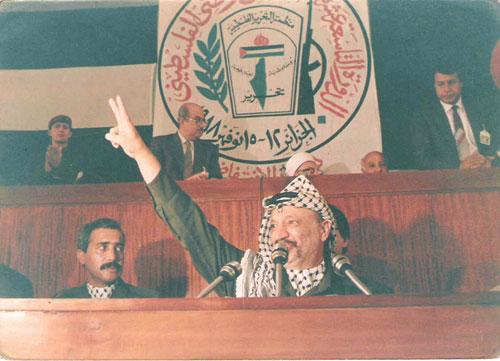
Five years later, on 15 November 1988, Yasser Arafat (pictured below) proclaimed the State of Palestine at a meeting of the Palestine National Council in Algiers. The UN General Assembly acknowledged the proclamation the following month and granted Palestine non-member observer state status in 2012.
Today, more than 150 UN members recognise Palestine, including the United Kingdom, which did so in September 2025.
2. Both spent centuries under Ottoman rule
Sultan Selim I’s armies defeated the Mamluks in 1516, bringing Palestine into the Ottoman Empire. A little over half a century later, Ottoman forces took Cyprus from Venice, completing the conquest with the fall of Famagusta in 1571.
Settlement from Anatolia helped establish the Turkish Cypriot community, while the island’s Orthodox Church regained privileges under Ottoman rule.
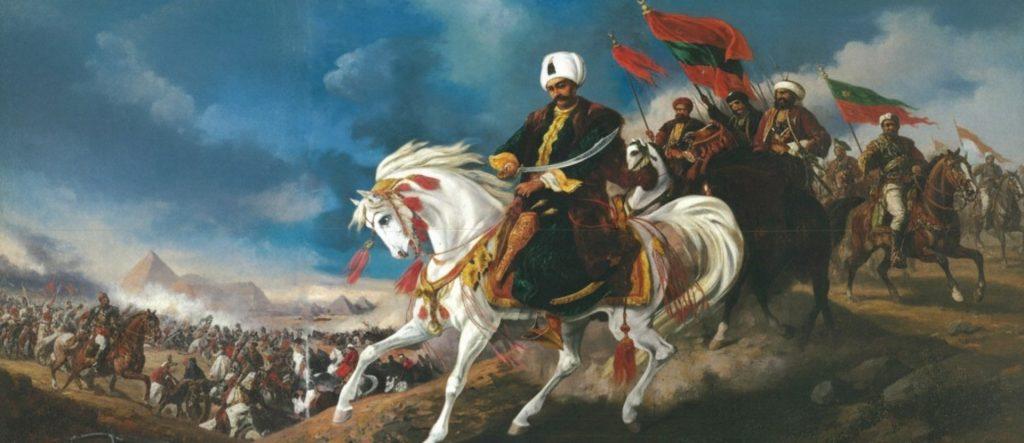
Sultan Selim I (1470–1520) was the ninth sultan of the Ottoman Empire, reigning for 8 transformative years. Image © Topkapı Palace
In Palestine, the Ottomans rebuilt Jerusalem’s city walls under Sultan Süleyman, and Jaffa grew into a busy port whose commerce helped sustain local life. Wealth was concentrated in towns and cities such as Jerusalem, Nablus, Gaza, Jaffa, and Acre, whilst those in rural areas tended to be more impoverished. Society was stable under the Ottomans, which oversaw multi-religious coexistence enabling Christians, Jews and Muslims to live side-by-side in peace.
3. British rule linked the two places in unexpected ways
Britain took over the administration of Cyprus in 1878, while the island formally remained Ottoman. It annexed Cyprus in 1914, made it a Crown colony in 1925 and retained the sovereign base areas of Akrotiri and Dhekelia when the Republic of Cyprus became independent in 1960.
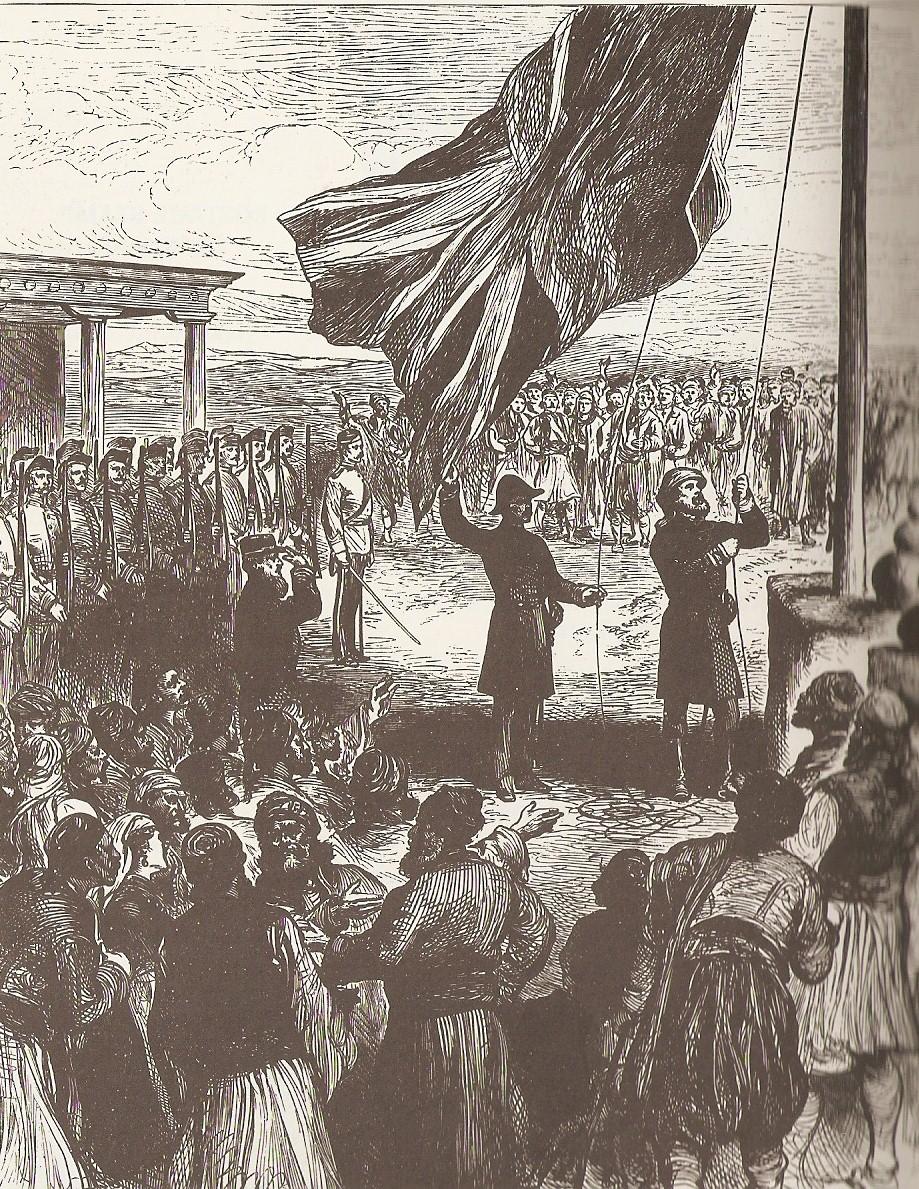
Hoisting the British flag at Nicosia on 12th July, 1878. the ceremony took place in the yard of Turkish Barracks (Kışla) on Tripoli bastion, attached to the buildings over Paphos gate. Illustration 8 October 1878 via Illustrated London News / Wikimedia
British forces captured Jerusalem in 1917 and took the rest of Palestine in 1918. Britain then administered Palestine under a League of Nations mandate approved in 1922, which ended in May 1948.
Between the 1920s and the late 1940s, poverty and drought helped drive a trade in marriages. Some four thousand Turkish Cypriot girls and young women were married to men from abroad. Most went to Palestine, with others travelling to Egypt, Syria or Jordan.
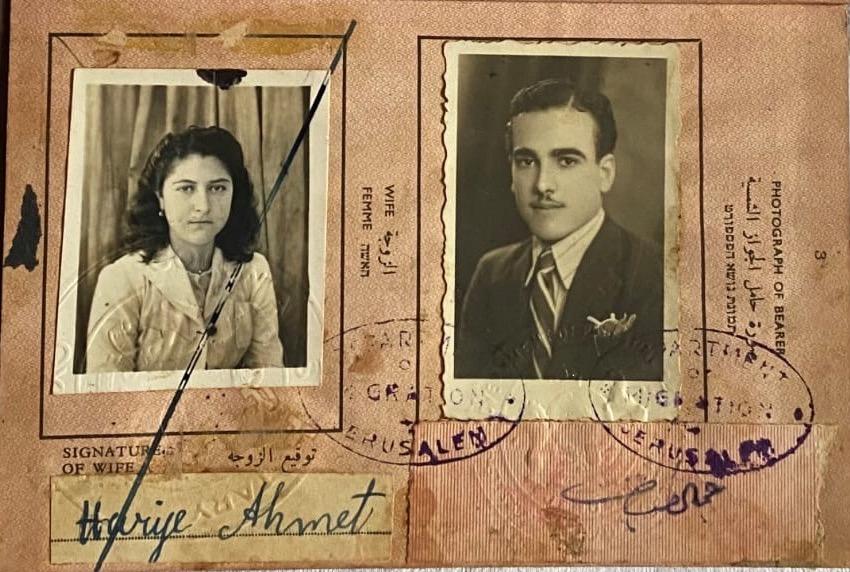
Turkish Cypriot bride Huriye Ahmet of Dali added to the British passport of her Palestinian husband Jamal Hafiz Daban so she could travel to Palestine with him after they wed in 1945
In some cases, as with Fetine, the groom paid the girl’s family. Many had little choice and arrived far from home with little or no Arabic. Some built happy lives and raised families. Others lost contact with Cyprus for good.
People were also sent in the opposite direction. From 1946, Britain intercepted more than 50,000 Jewish refugees, many of them Holocaust survivors, trying to reach Palestine and detained them in camps in Cyprus. The last camp closed in 1949, with around 53,000 people who had passed through there and the roughly 2,000 Jewish babies born in the camps—going on to Mandatory Palestine or, from 1948, Israel.
4. Britain’s choices shaped who held political power
In the 1917 Balfour Declaration, Britain backed a Jewish national home in Palestine and pledged to protect the civil and religious rights of the country’s non-Jewish communities. The declaration made no equivalent pledge about the political rights of the Palestinian Arab majority.
Under the mandate, Britain formally recognised a Jewish Agency to advise and work with the administration in developing the national home. There was no parallel body established for non-Jewish Palestinians. British forces later crushed the Palestinian Arab Revolt of 1936–39, using collective punishment and house demolitions.
Israel declared independence in May 1948 as the mandate ended. The war surrounding its creation drove roughly 750,000 Palestinians from their homes in what Palestinians call the Nakba, or catastrophe. Britain formally recognised Israel in 1950. It would be another 75 years before it recognised Palestine.
The UK’s uneven approach to the two sides also shaped the West’s policies to both, with Palestinians kept at arms’ length whilst relations with Israel deepened over trade, military ties and intelligence.
The 1960 constitution of the newly independent Republic of Cyprus established a power-sharing government between Greek Cypriots and Turkish Cypriots, each with veto powers in key areas, separate communal institutions and guaranteed representation in government and state institutions.
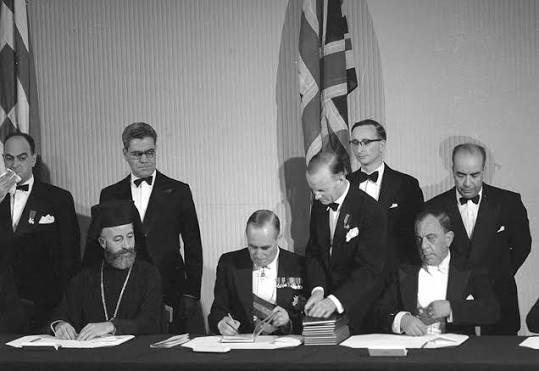
The partnership was under strain within a year. In September 1961, Vice-President Dr Fazıl Küçük wrote to President Makarios that he had learnt from newspapers of decisions affecting his veto powers. He also complained that Greek Cypriot ministers were agreeing positions among themselves before cabinet meetings and that the public service commission had failed to implement the agreed staffing ratio between the two communities.
The arrangement broke down after Makarios proposed 13 constitutional changes on 30 November 1963 that would have dismantled key safeguards of Turkish Cypriot political equality. Unsurprisingly, Turkish Cypriot leaders rejected them.
On 21 December 1963, Turkish Cypriots Cemaliye Emirali and Zeki Halil were shot dead by Greek Cypriot police in Nicosia. The killings sparked the violence known as ‘Bloody Christmas’. Hundreds were killed in the ensuing conflict, and Turkish Cypriot neighbourhoods and villages came under attack. In the first months of the conflict, an estimated 25,000 Turkish Cypriots, about a quarter of the community, fled to enclaves for safety.
Greek Cypriot officials took sole control of the central administration during the unrest and, fearing Turkish military intervention, called for an urgent Security Council meeting. On 4 March 1964, the Council unanimously adopted Resolution 186, authorising the deployment of a UN peacekeeping force with the consent of the “Government of Cyprus”, by then run entirely by Greek Cypriots. The resolution made no provision for restoring the Turkish Cypriots’ constitutional role in government.
The wording of Resolution 186 has entrenched the exclusion of Turkish Cypriots from the state they had co-founded, and many hold Britain responsible.
Britain backed the resolution despite being a permanent Security Council member with veto power and as one of three Guarantor Powers of Cyprus, it was duty bound to guarantee the Republic’s constitutional order.
Since the outbreak of the conflict Britain has continued to treat Greek Cypriots as the sole authority on the island, making pacts covering a host of areas including trade, education and military co-operation, whilst deliberately excluding Turkish Cypriots from such talks. When Cyprus started its accession talks with the European Union, Britain – then an EU member state – did not insist the division of the island be a prerequisite for it joining the bloc.
In recent years, Britain has gone further still in accommodating Greek Cypriot demands to treat them as the only recognised government, resulting in a growing pattern of discrimination against Turkish Cypriots in every sphere of life.
One of the biggest factors influencing British policy on Cyprus is undoubtedly preserving its two military bases, Akrotiri and Dhekelia, which are both located on the Greek side of the island.
5. The loss of waqf land
A waqf, or vakıf in Turkish, is an Islamic endowment. A donor might dedicate a plot of land, a shop or another property in perpetuity, with the rent supporting a good cause, such as a school, a mosque or relief for poor families. In Cyprus, the institution that administers these endowments is known as Evkaf (pictured below) and it is responsible for administering over 2,200 vakıf – most established during Ottoman rule.
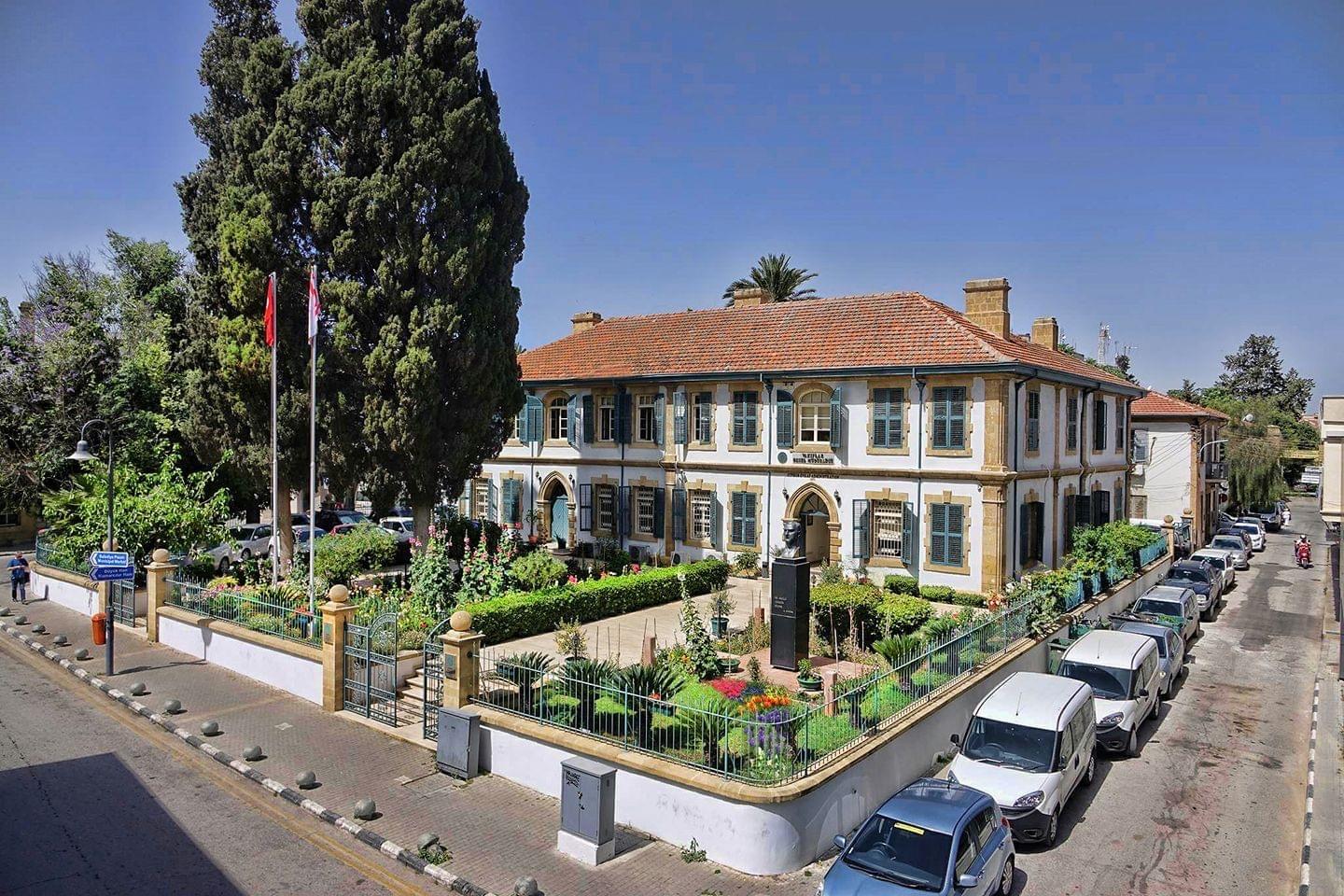
The 1878 Cyprus Convention provided for joint oversight of Muslim endowments by an Ottoman representative and a British appointee. Just five years later, an official report by Malcolm Seager proposed expropriating Evkaf’s assets. Historian Reyhan Sabri argues that the British pursued the report’s other option, gradually dismantling the vakıf system.
In 1925, the British governor appointed Sir Mehmet Münir as head of Evkaf. Three years later, Evkaf had become a colonial government department. Under British rule, substantial areas of endowed land passed into private ownership, often to existing tenants, despite such transfers of vakıf property being unlawful and Britain pledging to uphold the rules that protected vakıf land.
A 1955 law paved the way for Turkish Cypriots to regain control of Evkaf, but by then much of Evkaf property had already been lost. The fenced-off part of Varosha (Maraş) is one of the starkest examples cited by Evkaf.
Records show that Abdullah Paşa, Lala Mustafa Paşa and Bilal Ağa foundations originally held the entire area, about 4,638 dönüms, or 6.2 square kilometres. Evkaf’s analysis puts the land still recorded as vakıf property in Varosha at roughly one and a half dönüms. Evidence shows how the foundation’s name was systematically erased from title deeds when the island was a British colony.
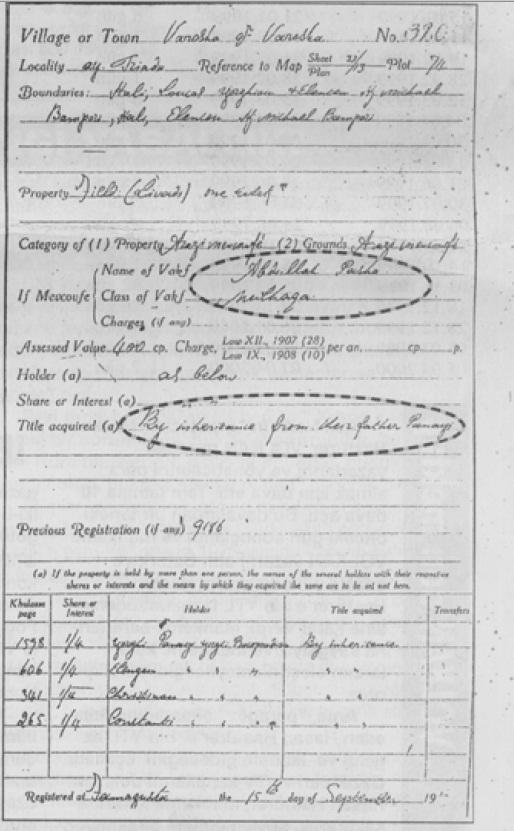
During the British Mandate, the Supreme Muslim Council administered much of Palestine’s waqf property. Inside Israel, the 1950 Absentees’ Property Law and its 1965 amendment brought endowed farms, shops and other assets under state control, cutting communities off from income that had supported religious and welfare services. Habitat International Coalition told the UN in 1995 that post-1948 seizures included more than 17,500 acres of waqf property, or about 70,800 dunums.
In occupied East Jerusalem, waqf property was lost within days of Israel’s capture of the Old City in June 1967. Israeli bulldozers razed the centuries-old Mughrabi, or Moroccan, Quarter to make way for the plaza at the Western Wall. More than 130 homes were destroyed in a neighbourhood sustained by the Abu Madyan waqf. An Israeli expropriation order the following year covered the site and adjoining parts of the Old City. Jordan told the UN that 465 of the roughly 700 buildings covered by that order belonged to Islamic endowments, including family waqfs.
The Jordanian-administered Jerusalem Islamic Waqf still manages the Al-Aqsa Mosque compound. Endowed property in East Jerusalem also faces pressure through Israeli land and planning laws. In 2015, Israel’s Supreme Court ruled that the Absentees’ Property Law could apply to East Jerusalem properties held by Palestinians living elsewhere in the West Bank.
Elsewhere in the occupied Palestinian territory, the risks range from loss of control over sites to physical destruction. In March 2026 the UN reported Israeli measures to shift powers over construction permits at Hebron’s Ibrahimi Mosque, also known as the Tomb of the Patriarchs, to Israeli authorities.
In Gaza City, strikes in December 2023 destroyed the main building of the Great Omari Mosque. Its library housed manuscripts endowed as waqf by Palestinian scholars. Some of the collection had been digitised before the war.
6. Recognition and security have followed different paths
On 15 July 1974, a coup backed by Greece’s military junta overthrew President Makarios and installed Nicos Sampson, an EOKA assassin who targeted British servicemen and civilians. He earned the nickname ‘Butcher of Omorphita’ for leading deadly attacks on Turkish Cypriots in 1964. His appointment as president a decade later raised fears of further mass killings.
Türkiye intervened militarily five days later, on 20 July, invoking the 1960 Treaty of Guarantee. By the August ceasefire, Turkish forces controlled a broad stretch of northern Cyprus, from Lefke in the west to Famagusta in the east.
For Turkish Cypriots who had lived through a decade of violence and displacement, the north offered a place to live in safety. The discovery of multiple massacres and mass graves of Turkish Cypriot civilians from Muratağa, Sandallar, Atlılar and Taşkent reinforced fears about their safety.
The fighting and its aftermath uprooted both communities. Around 160,000 Greek Cypriots, roughly a third of their community, fled or were forced south, and some 45,000 Turkish Cypriots moved north. UN peacekeepers have supervised the ceasefire lines ever since.
North Cyprus governs itself. International non-recognition limits its representation and restricts direct trade and travel. Turkish Cypriot athletes still face barriers to international competition, as the documentary UNSEEN shows.
Palestine has non-member observer state status at the UN, fields national teams in FIFA competitions and sends athletes to the Olympics. On the ground, Palestinian self-government is severely constrained.
Israel captured the West Bank, including East Jerusalem, and Gaza in the 1967 war. Israeli settlement expansion has taken up increasing amounts of Palestinian land in the West Bank, and many Palestinians displaced during the occupation remain unable to return home.
The Palestinian Authority exercises limited powers, including local policing in parts of the West Bank. Israel retains extensive control over movement and collects much of the tax revenue owed to the Palestinian Authority, which it routinely withholds.
In 2024, the International Court of Justice concluded that Israel’s continued presence in the occupied Palestinian territory was unlawful. It found that Israel retained key elements of authority over Gaza, including control over movement and trade, after withdrawing its troops and settlers in 2005. Amnesty International and the Israeli human rights organisation B’Tselem describe Israeli policies on land, housing and freedom of movement as part of a system of apartheid. Israel rejects the charge.
Israel’s war in Gaza, launched after the Hamas-led attacks of 7 October 2023, has devastated the territory. By 14 November 2026, Gaza’s health ministry had reported 74,695 Palestinians killed. A UN update published earlier in November listed nearly 22,000 children among those who had been killed.
The United States, Qatar, Egypt and Türkiye helped broker the October 2025 ceasefire in Gaza, although Israeli strikes, shelling and gunfire have continued to kill Palestinians, who are also deliberately deprived of vital aid to provide adequate shelter, sanitation and medical care for the 2 million displaced people.
In the West Bank, families are forced from their homes by Israeli demolitions and settler violence, and farmers attacked or blocked from reaching their olive groves during the harvest.
Unfortunately for Palestinians, there is no saviour, such as Türkiye, to militarily intervene to protect them, nor a UN peacekeeping force to prevent ongoing Israeli abuses against them.
By the time Pembe Mentesh learnt what had become of her great-aunt, Fetine had died. Pembe traced Fetine’s descendants to the West Bank and Jordan and went to meet them. Some later travelled to Cyprus to discover their Turkish Cypriot roots.
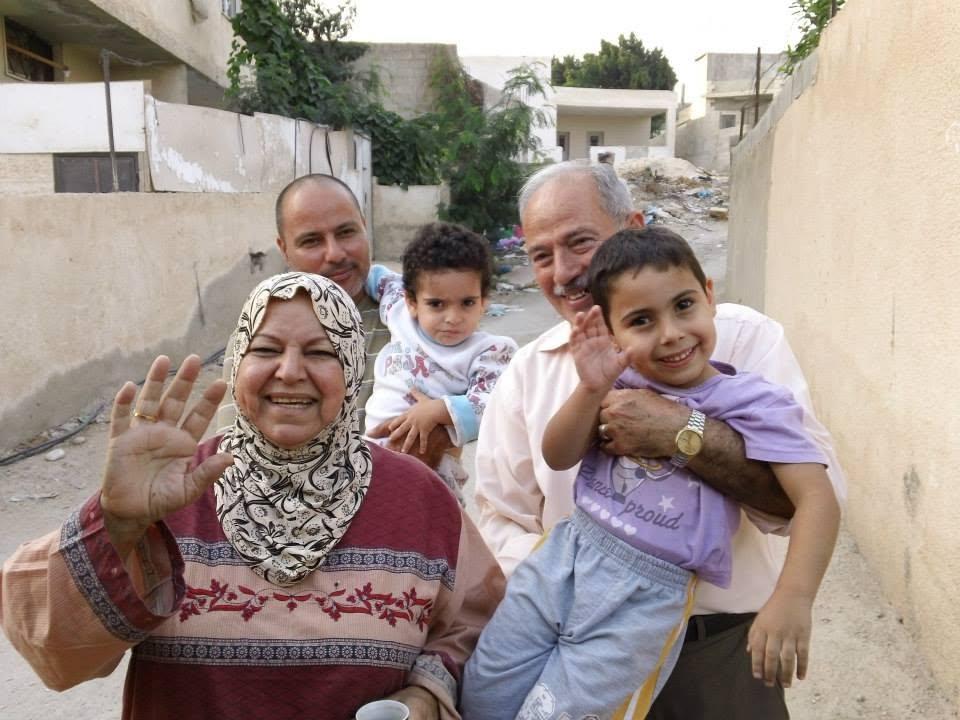
Pembe Mentesh's Palestinian relatives through her great-aunt Fetine. Photo © Facebook/Missing Fetine
Pembe’s search began with a single photograph. On a day that marks two declarations of independence, Fetine’s story offers a more personal link between the two places. After decades apart, both branches of her family can now pass that story on together, highlighting their shared cultural heritage and entwined histories.
Watch Missing Fetine (2017) documentary here: