


An Open Letter to the President and Decision-Makers of the Turkish Republic of Northern Cyprus
Days after the French authorities approved the extradition warrant for a Lithuanian woman wanted by the Republic of Cyprus in connection with her work in the North Cyprus property sector, the Greek Cypriot side was also celebrating its success in stopping a major international music festival scheduled to take place in Girne next month.
Now, following objections and diplomatic intervention from the South, FC Barcelona has reportedly postponed its planned youth academy camp in Lefkoşa - another example of how pressure is being deployed to restrict the TRNC's engagement with the outside world.
The South now appears to have other international events scheduled for the Turkish Republic of Northern Cyprus ('TRNC') firmly in its sights with a view to obstructing these as well.
Meanwhile, hundreds of property developers, lawyers, estate agents and property owners in the North are once again living on edge, wondering whether they too could face an arrest warrant when travelling abroad.
A state's first duty is to protect its citizens. It is increasingly difficult, however, to see how the authorities in the TRNC are adequately discharging that duty in the face of the intensifying challenges confronting the country and its residents, who have already endured decades of international isolation.
One thing is clear: the TRNC Government can no longer wish away these crises with tough-sounding statements and reactive assurances.
The Greek Cypriot campaign against the TRNC has become sustained and increasingly sophisticated, operating across legal, political and international arenas, with consequences far beyond individual obstructions and prosecutions.
The property crisis, in particular, is creating fear among investors, developers, purchasers and ordinary families. It threatens confidence in a vital sector, with serious ramifications for the economy and, ultimately, the future of the TRNC itself.

TRNC President Tufan Erhürman. Photo via Facebook
But this crisis must also be understood in its wider context.
For decades, Turkish Cypriots have lived with the consequences of an unresolved Cyprus problem in which their political and legal rights have too often been subordinated to a biased and inaccurate narrative that has been too readily accepted by the international community. Their claims, rights and interests – to which they are entitled under international law - have repeatedly been marginalised, while the international human rights arena has too often remained silent.
The present property campaign risks deepening that imbalance still further.
This is therefore not simply a question of defending individual cases. It forms part of the continuing struggle to ensure that the rights, security and future of Turkish Cypriots are treated as matters of equal legitimacy and international concern.
That requires not only an effective legal defence, but also a clear and authoritative legal counter-narrative: one capable of challenging the assumptions and claims that have shaped international understanding of the Cyprus issue for decades.
Yet the response remains inadequate. There have been meetings. There have been discussions. There have been assurances that the issue is being considered.
But consideration is not a strategy. Statements are not a defence.
And the passage of time is not neutral. Every month of inaction allows the Greek Cypriot campaign to become more entrenched, more effective and more difficult to reverse.

Nikos Christodoulides, president of the Cyprus Republic. Photo via Facebook
The Greek Cypriot authorities have long benefited from their position as the sole internationally recognised authority on the island and, in the view of many Turkish Cypriots, have exploited that position to advance their interests at the expense of Turkish Cypriot rights.
They understand that a single prosecution can have consequences far beyond the courtroom: a criminal case can become an arrest warrant; an arrest warrant can become an international travel risk; and the cumulative effect can deter investment and create uncertainty far beyond the individual case.
This is not simply a dispute about one property or one defendant at a time. It is a strategic campaign with the potential to undermine the viability of the TRNC itself. It requires a strategic response.
The TRNC has capable lawyers and valuable institutional knowledge. The issue is not whether they should be replaced. The question is whether the present arrangements are sufficient for a challenge that now extends across domestic and international law, criminal proceedings, extradition and international enforcement, strategic litigation, evidence, diplomacy, international advocacy and public relations.
A properly funded and coordinated Defence Platform would provide the means to bring these capabilities together, while adding the specialist international expertise, coordination and long-term capacity that the present challenge demands.
It must also address the wider imbalance in the property debate: the legitimate claims of Turkish Cypriots to property or compensation in the South, where there is no equivalent practical mechanism to the Immovable Property Commission providing comparable redress.
Nor can the response be confined to the property issue alone. The North must also appeal to the international community's sense of fairness to allow Turkish Cypriots, as a people, to participate on the world stage—whether in sport, trade, academia or political representation.
The systematic obstacles they face must be exposed for what they are: attempts to deny Turkish Cypriots opportunities and forms of participation that others take for granted.
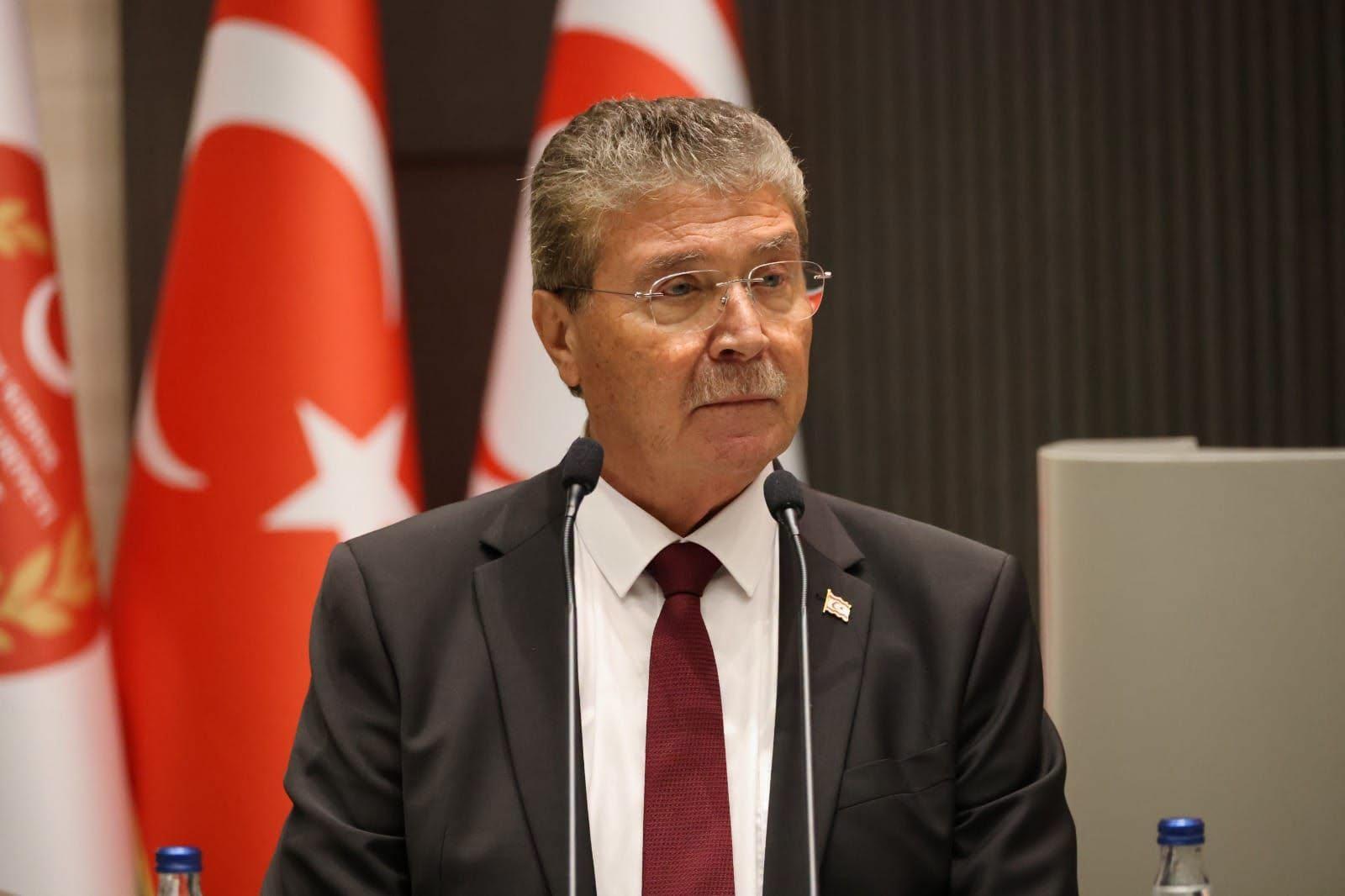
TRNC Prime Minister Ünal Üstel, Aug. 2026. Photo © TRNC Prime Ministry
The question for the TRNC political leadership is now straightforward:
Is the TRNC prepared to continue reacting, or is it prepared to act?
Indecision has a cost. Delay has a cost. Inaction has a cost. Those costs are already being paid by individuals facing prosecution, businesses facing uncertainty and a society increasingly concerned about its future.
The greatest danger is that, years from now, the consequences will be described as “inevitable”.
They are not inevitable. But neither will they be prevented by words alone.
The campaign against the North is organised, sustained and strategic. The response to it must now be organised, sustained and strategic too.
The Turkish Cypriot people deserve no less.
History will not judge the TRNC's leadership by how many statements it issued. It will judge whether, when the threat became clear, it had the courage and foresight to act.
Lennart Poulsen is a London-based barrister practising in international law and human rights. He has written extensively on the Cyprus property issue, including for The Barrister magazine.