Unfortunately, when it comes to losing people that we love, our emotions are usually uncontrollable for a long time afterwards.
There is never a good time to lose the people we love most, but in this period of great uncertainty and fear, somehow the loss of a loved one seems more amplified because of the short time involved between diagnosis and loss.
One minute they are here with us, the next lost, in an untimely manner.
So how do we as human beings deal with and cope with such painful emotions?
After the initial shock where we are left feeling numb and inconsolable in our sadness, we go through a very difficult process indeed, described as the ‘Grieving Process’.
The Grieving Process
This process we invariably go through comprises of five stages. There is no time frame for each stage, and sometimes we can flip back to a stage which we have already experienced previously.
The five stages of bereavement that we go through are:
DenialAnger BargainingDepressionAcceptance
Let’s look at them in greater detail to understand what they mean.
DENIAL
Denial is the first stage that hits us. We are consumed with feelings of disbelief and non-acceptance, where we struggle to understand what has happened and we struggle to believe what we have just experienced.
We ask ourselves questions like this: “How could this have happened?”
We say things like, “This can’t be true!” “Surely it’s a mistake,” and “I don’t believe this is happening.”
ANGER
After Denial we experience Anger. This is perhaps the most destructive stage we go through. The pain hits us and we then lash out, looking to blame someone or something as we struggle to cope with our loss.
These are the types of things we say when we are angry, and the types of questions we ask at this stage of the process: “I need to find who’s at fault.”
Or, “Someone needs to pay for this!” We want to know, “Whose fault is this?”, and “Where can I find out who is to blame?”
BARGAINING
During this stage, we question what has happened and try to work out if things could have been done differently. We look for answers, and we look for reasons as we try to work out what has happened and why.
Our brains try to make sense of what has happened, as we try to apply some logic to an illogical situation.
This is how we try to understand, work out and process what has happened to us: “Could I have done something differently?” “What if we had tried that instead?”
We think, “If only I did this and not that,” and “Maybe the outcome would have been different if we didn’t do what we did.”
DEPRESSION
The part of the Grieving Process which is the most painful is the Depression stage. We are left empty and distraught as the gravity of our loss hits us.
We are numb with pain, and we struggle to think clearly as we are enveloped in utter sadness and emotional pain. We cry. We distance ourselves from other people. And we are consumed in our own world of loss and emptiness.
We can’t think about anything other than our loss, as we function on ‘auto -pilot’, not really being aware of what we are doing and why. It’s as if our brains shut down and function at a bare minimum.
Some people struggle to sleep, while for others, they struggle to wake up as they sleep excessively as a way to cope with the pain. Normal day-to-day living stops as we live in a zombie like state until we reach the final stage of the whole process.


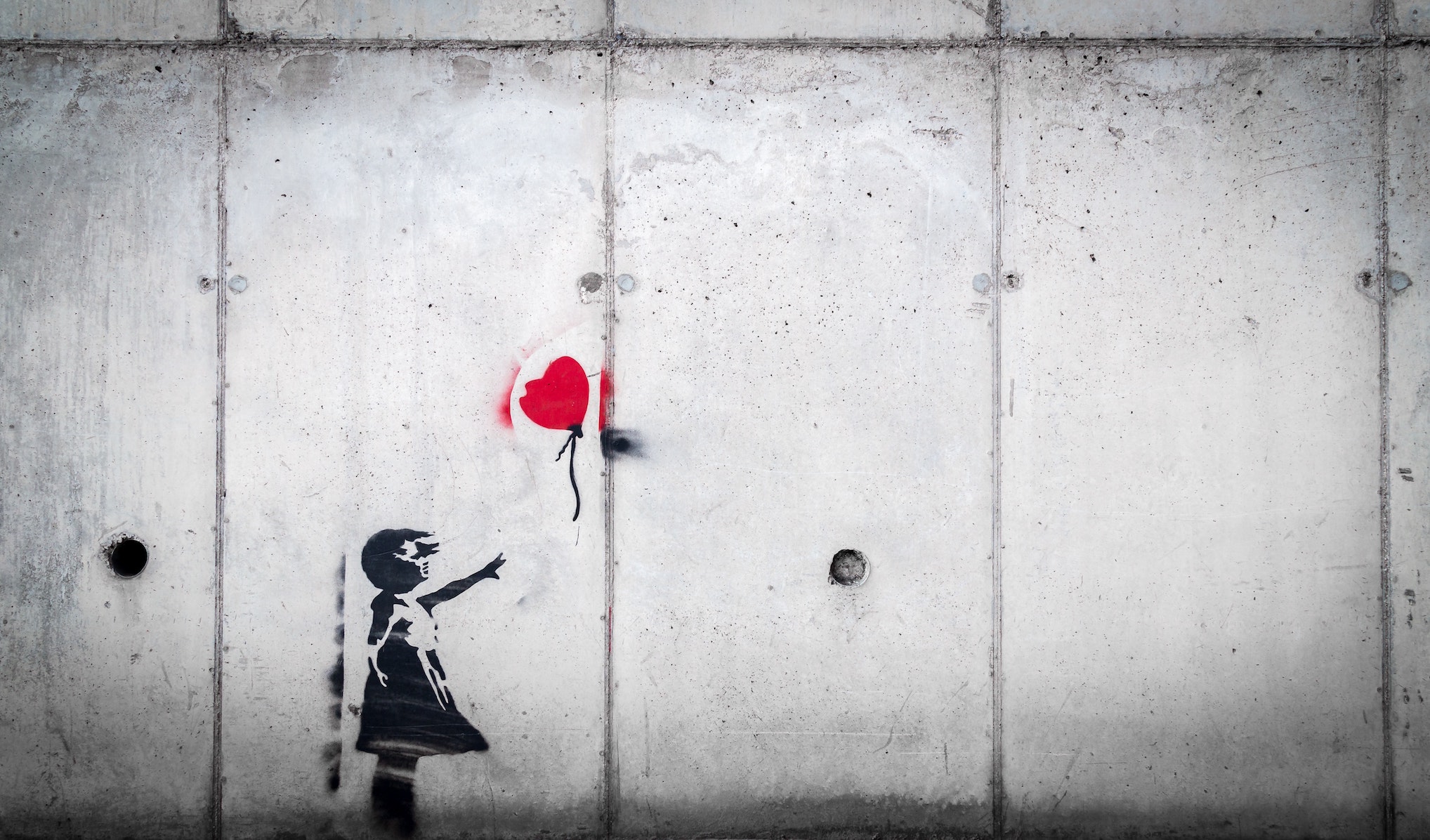 Wall mural of girl releasing heart-shaped balloon, Oasis, Casablanca, Morocco. Photo © Karim Manjra / Unsplash
 Dr D. U.Sivri