Nizami Ganjavi is one of Azerbaijan’s greatest poets and thinkers. Following a decree by the President of the Republic of Azerbaijan, Ilham Aliyev, in Janury, 2021 was declared the "Year of Nizami Ganjavi". The aim is to promote Nizami throughout the world and to further explore his legacy.
It should be noted that although there are many references in world literature to this great man’s work, which reflects universal human values, Nizami's writings deserve to be promoted more widely internationally.
For Azerbaijanis, Nizami Ganjavi is mentioned in the same breath as other prominent classic names in world literature. Like Dante, Servantes, Shakespeare, Honoré de Balzac, and Victor Hugo, Nizami was a master of prose. This twelfth century writer is the national pride of the people to whom he belongs, while also belonging to the elite group of world class literary figures.
He was born as Muhammad Ilyas in 1141 in Ganja, the second largest city in Azerbaijan, which at that time was part of the Selcuk Empire. Acquiring the pen-name Nizami Ganjavi, this great Azerbaijani poet and philosopher remained in the city all his life until his death in 1209. During this time, Nizami mastered the sciences of the Middle Ages, which underpinned his life philosophies.
His literary expressions began with the creation of a lyrical poem. He went on to author famous ghazals (an ancient artform comprising of short poems of rhyming couplets that deal with love and loss) and odes.
Nizami’s best known poetic work is the epic "Khamsa", also known as ‘Panj Ganj’, or ‘Five Treasures’, as it combines five long poems written in the form of distich (couplet). These five poems are: "Treasury of the Mysteries", "Khosrov and Shirin", "Layla and Majnun", "Seven beauties" and "Iskendername".
Opening of a manuscript of "Khamsa_of_Nizami", British Library
Widely regarded as a sage during his lifetime, Nizami’s legacy reflects noble human ideas. He called on people to act with dignity and generosity.
Nizami is the first poet in Eastern literature to describe a woman as ‘a being with high human qualities’. He argued that women can be active in various spheres of life on an equal terms with men.
His literary works and ideas are widely appreciated and shared by not only Azerbaijanis, but also Afghans, Iranians, Turks, Kurds and Tajiks, and far beyond including in Europe.
Isa Habibbayli, an Azerbaijani scientist and academic, described the many qualities associated with Nizami Ganjavi and his rich legacy:
“His works contain instructive plots and bright, thought-provoking images from the lives of many countries and peoples of the world.
“The famous poems immortalised in the masterful "Khamsa" are like an encyclopaedia of literature of the East and the West. Nizami Ganjavi skilfully pulls together the events and personalities of a huge area from Greece to India, from Arabia to Russia, from Iran to the Balkans.
“Through the works of Nizami Ganjavi, which have been translated into [multiple] world languages, the peoples of Europe have gained the opportunity to learn about the East more widely. In this sense, Nizami Ganjavi is the greatest guide of the Eastern world and Azerbaijan in the Western countries and in the world in general.”
“For richness and fineness of metaphor, accuracy, and profundity of psychological observation, and sheer virtuosity of storytelling, Nizami is unequalled”



 Opening of a manuscript of "Khamsa_of_Nizami", British Library
 Salīm conversing with Majnun in the desert. Nizami's text illustrated with a miniature painting from a late 16th-century Indian book, Bodleian Library
 Khusrau stand on either side of the canal built to supply Shirin with the milk of goats and cows, taken from the Khamsa of Nizami
 King Qizil Arslan, of the Atabegs of Azerbaijan (Turkic tribe) welcomes the poet Nizami
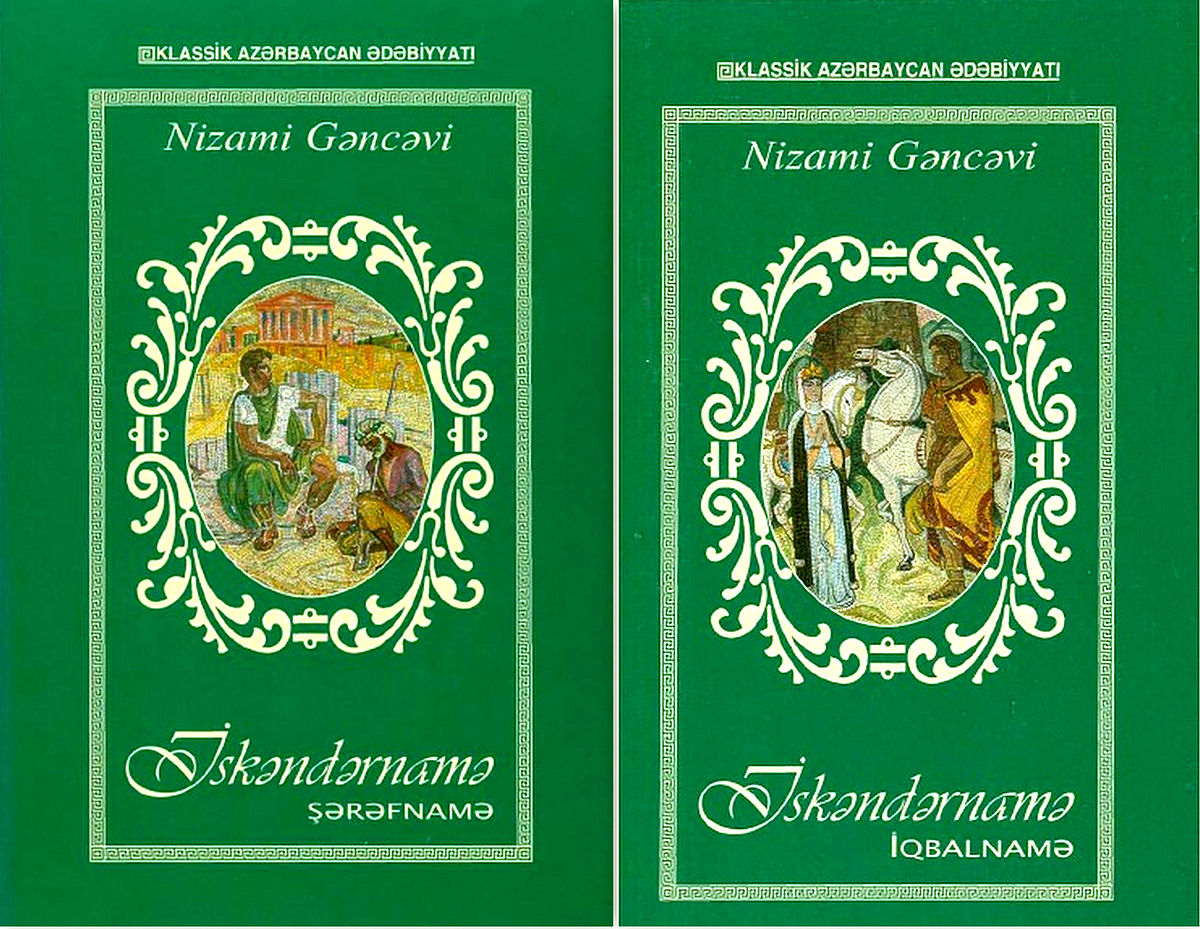 Iskendername - the final epic work by 12th century Azerbaijani writer and poet Nizami Ganjavi
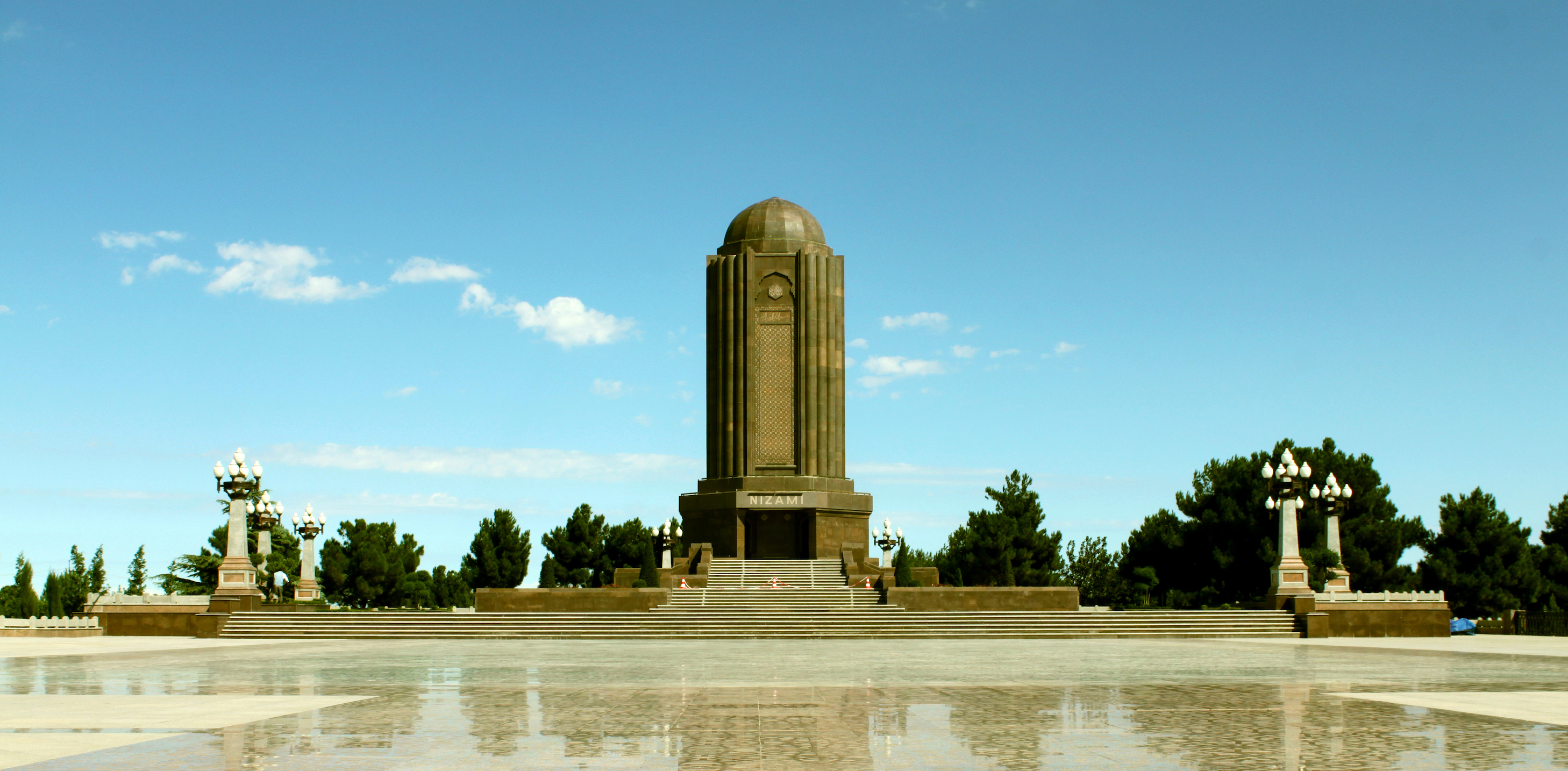 The Nizami Mausoleum in Ganja, Azerbaijan, 2013. Photo © Urek Meniasvili / Wikipedia, CC-By-SA 3.0