

A landmark new defence pact between Türkiye, Saudi Arabia and Pakistan is being hailed as the possible beginning of a new regional security order, with some already dubbing it a “Muslim NATO”.
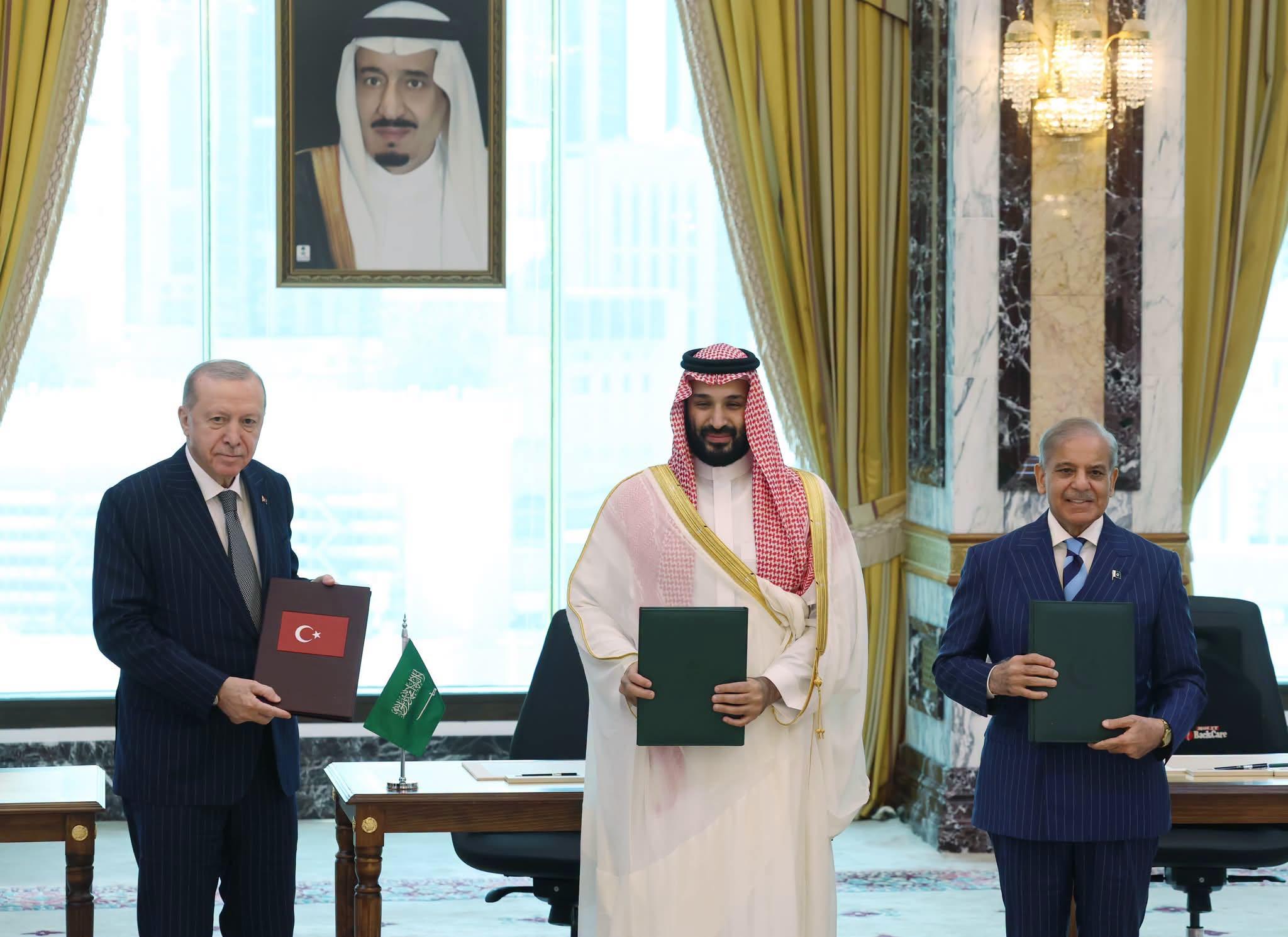
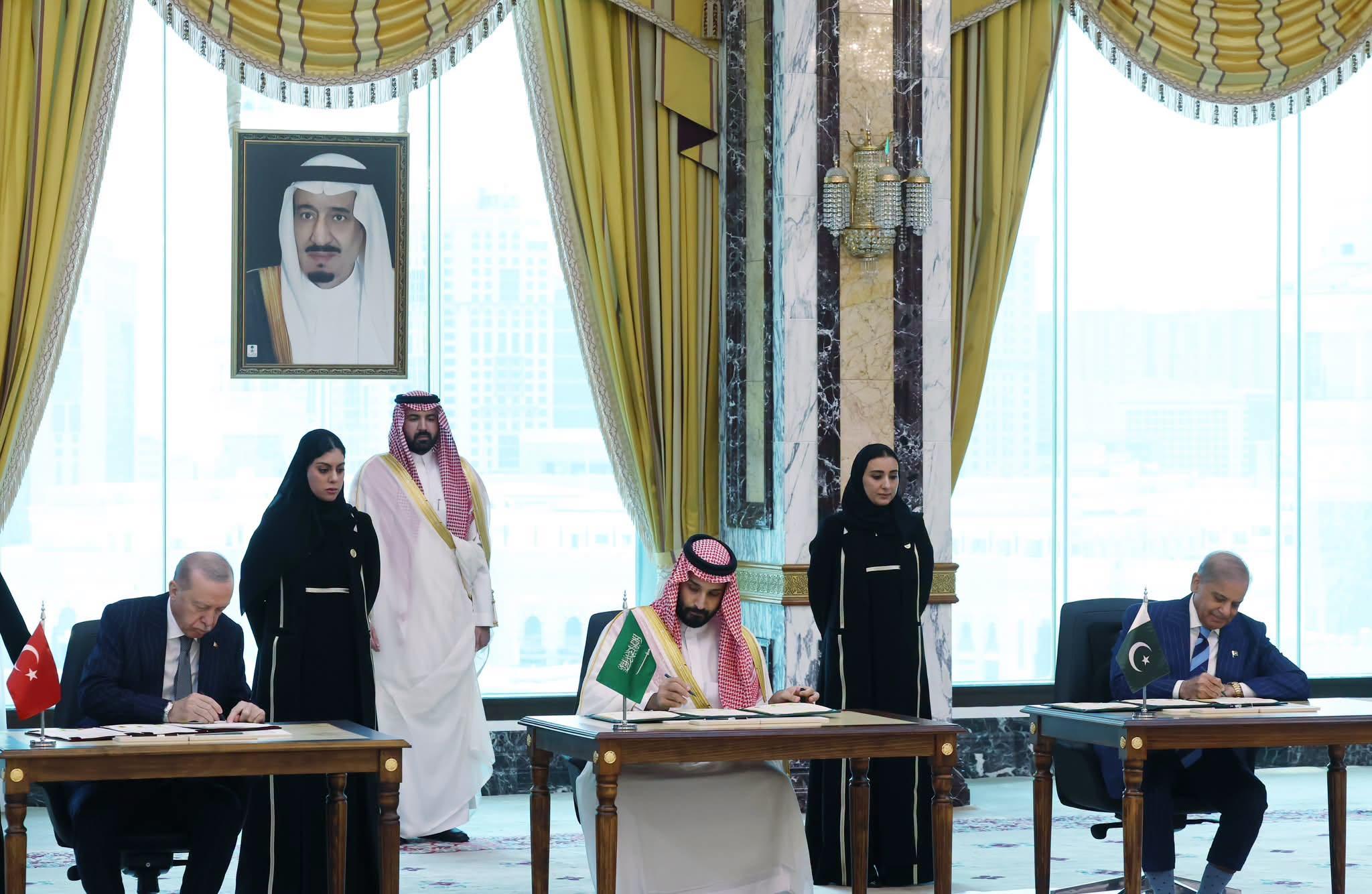
The Mecca Joint Defence Agreement, signed by Turkish President Recep Tayyip Erdoğan, Saudi Crown Prince Mohammed bin Salman and Pakistani Prime Minister Shehbaz Sharif in the Saudi holy city on 7 August, contains a striking collective defence commitment: an armed attack against any one of the three states will be regarded as an attack against all.
The wording inevitably invites comparisons with NATO’s Article 5. Turkish Foreign Minister Hakan Fidan has himself described the principle as “technically the same” as NATO’s collective defence clause. Yet what that means in practice is considerably more nuanced.
Fidan said the three states would consult over the degree and form of assistance required following an attack, meaning the pact does not necessarily commit Türkiye, Pakistan or Saudi Arabia to automatically entering a war on another member’s behalf. A ministerial committee and permanent secretariat based in Saudi Arabia are to be established, while many of the detailed operational arrangements are still to be agreed.
Türkiye’s Defence Ministry has since revealed that the agreement envisages joint exercises involving land, naval and air forces, closer co-operation on air defence and unmanned systems, and deeper defence-industry ties encompassing joint development, production, technology transfer, maintenance and logistics. Electronic warfare, autonomous systems and artificial intelligence are among the areas expected to receive particular attention.
It is therefore far more than a symbolic declaration of Muslim solidarity – although whether it eventually develops into anything resembling NATO remains another matter.
Why now?
The pact comes against the backdrop of extraordinary instability stretching from the Gulf and Iran to Yemen, Syria and the Eastern Mediterranean.
The latest upheaval has followed the US-Israeli attack on Iran in February and subsequent Iranian and allied attacks across the region, including strikes affecting Gulf states and vital energy and shipping infrastructure. Saudi Arabia in particular has become increasingly concerned about its vulnerability to missiles and drones, including attacks by Yemen’s Iran-aligned Houthis.
At the same time, many regional governments are questioning whether they can continue relying as heavily as before on Washington to guarantee their security.
Ahmed Aboudouh, Associate Fellow at Chatham House’s Middle East and North Africa Programme, believes the Mecca Pact should be understood primarily as an “experiment in regional self-reliance”, rather than a fully fledged war-fighting alliance.
He argues that comparisons with NATO are currently overblown: there is no declared Pakistani nuclear umbrella covering Türkiye or Saudi Arabia, while the publicly available agreement lacks NATO’s sophisticated integrated military structure and decades of institutional development.
Yet Aboudouh also sees potentially profound consequences. Saudi Arabia gains another layer to its security architecture and reduces its dependence on America; Pakistan gains greater Middle Eastern relevance and potentially Saudi economic support; and Türkiye gains access to Saudi capital and a huge new market for its rapidly expanding defence industry.
That last element could prove particularly important for Ankara.
Türkiye has spent the past decade building one of the world’s fastest-growing indigenous defence sectors, encompassing drones, warships, missiles, electronic warfare and increasingly sophisticated air-defence technology. Under the pact, Turkish companies could find not simply customers in Saudi Arabia and Pakistan, but partners for joint development and production.
The agreement also gives Ankara a more prominent role in Gulf and Red Sea security – something Türkiye increasingly regards as directly connected to its own trade, energy and maritime interests. Ankara has separately said it wants to participate in efforts to secure Red Sea shipping from Houthi attacks.
A challenge to America – or useful burden-sharing?
The new pact has inevitably raised questions over whether three traditionally close US security partners are beginning to construct an alternative to Washington.
US President Donald Trump, however, has publicly welcomed the agreement. Writing on Truth Social on Sunday, he said he was “very happy” to see the three countries sign the pact and presented it as evidence that Middle Eastern states were becoming better able to defend themselves.
That reaction fits Trump’s long-standing demand that American allies assume more of the cost and responsibility for their own defence.
The Lowy Institute describes the agreement as both an opportunity and a warning for Washington. Better regional air and missile defence, maritime security and military burden-sharing could complement American interests and reduce the demands placed on US forces. Türkiye can contribute NATO-compatible military planning, while Pakistan offers considerable manpower and operational experience.
But greater regional military capability also means greater political independence.
Ankara, Riyadh and Islamabad could increasingly co-ordinate positions on Iran, Israel, China and regional conflicts that do not necessarily match Washington’s preferences. Pakistan’s close defence relationship with China also creates potential complications for intelligence-sharing and military technology.
The Independent, in an analysis published on Tuesday, similarly notes that the agreement does not necessarily represent a rejection of America. Chatham House analyst Galip Dalay told the newspaper that the US remains indispensable to the region, while also becoming increasingly unpredictable. European Council on Foreign Relations analyst Hugh Lovatt suggested the pact could even suit Washington’s desire for regional partners to shoulder more of their own security burden.
So, rather than replacing the US, the Mecca Pact may initially give its members another option – strengthening their bargaining power with Washington without severing existing relationships.
Iran, Israel and India are watching closely
Despite the circumstances surrounding its creation, Türkiye, Saudi Arabia and Pakistan insist the agreement is not directed against Iran – or any other specific country.
Tehran has responded surprisingly cautiously. Iranian Foreign Ministry spokesman Esmaeil Baghaei said Iran saw no reason to fear the arrangement, portraying greater regional responsibility for security as potentially preferable to dependence on outside powers, provided such co-operation correctly identifies the sources of regional threats.
Israel presents a more complicated question.
The agreement does not identify Israel as an adversary and the three states have avoided presenting it as an anti-Israeli military coalition. Nevertheless, The Independent reports that analysts believe growing concern about Israeli military actions across the region has contributed to the calculations behind the pact. Lovatt described the grouping politically as something of a “counter-Abraham Accords axis” – states willing to work with Washington but increasingly wary of Israel’s regional ambitions.
India is also following developments closely because Pakistan is one of the three members. New Delhi’s Ministry of External Affairs has said it is assessing the pact’s implications for Indian national security and regional stability and will take whatever measures it considers necessary to protect its interests.
That highlights one potential danger for Türkiye: a collective defence structure stretching from the Eastern Mediterranean to South Asia could eventually expose Ankara to crises – from Pakistan-India hostilities to Saudi-Iranian confrontation – in which Türkiye itself has little desire to become militarily embroiled.
Will Egypt join?
The most obvious candidate for enlargement is Egypt.
Türkiye, Saudi Arabia, Pakistan and Egypt have already been working together informally on regional security through a four-country format, while Erdoğan and Fidan have both publicly said Cairo could eventually join the Mecca arrangement.
Egyptian Foreign Minister Badr Abdelatty has said Cairo is studying the agreement “very seriously”, but stressed that membership would require careful examination of Egypt’s constitutional and legal obligations.
Aboudouh believes Egypt has good reasons to wait.
Cairo traditionally prefers to preserve freedom of manoeuvre rather than become trapped inside formal military blocs. Membership could also complicate its relationships with countries whose interests sometimes collide with those of Türkiye, Pakistan or Saudi Arabia – among them Israel, India, the UAE, Greece and the Republic of Cyprus.
His assessment is that the risks currently outweigh the rewards for Egypt, although that calculation could change as the pact develops.
Egyptian membership would nevertheless be transformative. It would bring the Arab world’s most populous country and one of its largest armed forces into an alignment stretching from the Eastern Mediterranean and Red Sea through the Gulf to South Asia.
At that point, descriptions of an emerging Muslim security bloc would become considerably harder to dismiss.
Could North Cyprus benefit?
For Turkish Cypriots, expectations should remain realistic.
The Turkish Republic of Northern Cyprus is not part of the Mecca Pact, and the agreement’s collective defence guarantee applies to Türkiye, Saudi Arabia and Pakistan themselves. The TRNC continues to be formally recognised only by Türkiye.
There is therefore no basis at present for suggesting that an attack on North Cyprus would automatically trigger Pakistani or Saudi military assistance.
The possible benefits are instead indirect and geopolitical.
Türkiye remains the Turkish Cypriots’ principal security guarantor and overwhelmingly their most important diplomatic partner. Anything that strengthens Ankara’s regional influence, military capabilities and relationships with major Muslim states potentially gives it greater leverage when Turkish Cypriot security and political rights are discussed internationally.
There is already an institutional connection: the Turkish Cypriot state participates in the Organisation of Islamic Cooperation as an observer under the name “Turkish Cypriot State”.
Closer Turkish strategic ties with Riyadh and Islamabad could therefore create additional opportunities for Ankara and Turkish Cypriot officials to push for greater political engagement, trade, investment and international visibility – although neither Saudi Arabia nor Pakistan currently recognises the TRNC, and nothing in the Mecca agreement suggests that recognition is imminent.
Egyptian participation could prove particularly interesting.
Chatham House notes that Cairo’s existing relationships with Greece and the Greek Cypriot-administered Republic of Cyprus are among the considerations making Egypt cautious about joining a Türkiye-centred security arrangement.
Should Egypt ultimately join, the very act of embedding Ankara and Cairo inside the same defence and political-security structure could help dilute the rival blocs that have characterised the Eastern Mediterranean in recent years. That would not automatically produce Egyptian support for the Turkish Cypriot position, but it could provide Türkiye with more diplomatic room to ensure Turkish Cypriot interests are not excluded from future regional arrangements.
A Muslim NATO? Not yet
The Mecca Pact is therefore better regarded as the beginning of an experiment than the finished product.
NATO has 32 members, an integrated military command, established headquarters, common planning structures and more than seven decades of institutional experience. The Mecca grouping currently has three members, a collective-defence pledge whose practical limits remain uncertain, and institutions that have barely begun to be created.
Even Fidan has urged modest expectations, saying the three countries need to take “very humble but concrete steps” rather than pretend they have suddenly replicated NATO.
The first real test will come when one member faces a sufficiently serious attack and asks the other two for assistance. As Aboudouh notes, how Ankara, Riyadh and Islamabad respond will reveal far more about the pact than the language of the signing ceremony.
Yet its political significance should not be underestimated.
After decades in which Middle Eastern security has largely revolved around American power, Türkiye, Saudi Arabia and Pakistan are signalling that influential regional states want a greater say in building their own security architecture.
For Türkiye, that could mean new defence markets, Saudi investment, greater strategic reach and increased leverage with both Washington and its regional rivals.
And while Turkish Cypriots are not covered by the agreement, a stronger and more regionally connected Türkiye could ultimately give Ankara more tools with which to advance their security, economic and diplomatic interests.
Whether the Mecca Pact becomes a genuine Muslim counterpart to NATO or remains a looser partnership will depend on what happens next – particularly whether Egypt joins, how deeply the three militaries integrate, and, above all, whether they are actually prepared to defend one another when the promise is finally tested.